

The History of the Cotswolds
Starting in prehistory, how the Cotswolds evolved from early settlements to featuring some of the UK's most remarkable cultural landmarks.

England's Timeless Countryside
There is an England that looks untouched by time.
You will find it along winding country lanes bordered by ancient stone walls, in villages of honey-coloured cottages, beside centuries-old inns where fireplaces glow on winter afternoons, nestled in green hills dotted with sheep.
The Cotswolds is one of England’s most beautiful and historic regions and an irresistible destination for travellers seeking the quintessential English countryside.
Its story stretches back thousands of years, encompassing prehistoric communities, Roman settlements, medieval wool merchants, grand manor houses and some of the most influential figures in British design.
The old stone walls, market squares and church towers tell a story that has been unfolding for millennia.

The Cotswolds Before the Romans
Long before England existed, people were farming these limestone hills.
The Cotswolds contains remarkable traces of prehistoric settlement, including Neolithic burial chambers constructed more than 5,000 years ago.
One of the finest surviving examples is Belas Knap, near Winchcombe. Hidden within the countryside, this ancient long barrow was built during the Neolithic period to use as a communal burial place.
Over time communities built hillforts across the region, taking advantage of the elevated landscape. These ancient monuments provide a striking contrast to the elegant country houses and postcard-perfect villages for which the Cotswolds is now famous.
They are reminders that people have been drawn to these hills for thousands of years.

Roman Britain and the Rise of Cirencester
Arriving in Britain in AD 43, the Romans built straight roads, established towns and exquisite villas and introduced an entirely new way of life.
Few places in the Cotswolds demonstrate their influence better than Cirencester.
Known to the Romans as Corinium Dobunnorum, the settlement developed into one of the most important towns in Roman Britain.
Wealthy villas appeared throughout the surrounding countryside, featuring magnificent mosaics,
sophisticated heating systems and elaborate decoration.
One of the most extraordinary surviving examples is Chedworth Roman Villa, where visitors can discover intriguing archaeological remains that echo Rome’s glory.
For those thinking that Roman history is only encountered in Italy, discovering substantial Roman remains among the green hills of rural England can be one of the Cotswolds' unexpected pleasures.

Wool - the source of the Cotswolds’ wealth
To appreciate why the Cotswolds looks the way it does today, you must understand the value of sheep.
During the Middle Ages, the region became famous for exceptional quality wool. Sheep such as the Cotswold Lion breed thrived on its limestone grasslands, and Cotswold wool became an important commodity that brought extraordinary riches to its merchants. From the Cotswolds the wool was traded in London and Bristol and then exported to the great textiles centres in Flanders and Italy.
They invested their fortunes in manor houses, market buildings and magnificent ‘wool’ churches. Many of
the impressive medieval churches that still dominate Cotswold towns are closely associated with the fortunes of that age’s entrepreneurs.
In towns such as Chipping Campden and Northleach, the architecture provides a glimpse of just how lucrative the medieval wool trade could be. Even the design and scale of the towns reflects the realities of moving large numbers of sheep through towns for trade.
Walk through these towns today and the wealth of medieval England remains remarkably tangible.

The Story Behind the Famous Cotswold limestone
Few things say 'Cotswolds' like a picturesque cottage built from warm golden limestone.
The distinctive Cotswold stone is one reason why the region enjoys such visual harmony. For centuries, local limestone was used to construct cottages, churches, barns, manor houses and the dry-stone walls that still divide the countryside.
Its colour changes subtly across the region, ranging from pale cream to deep honey and warm gold.
And over time the weather softens the stone, allowing buildings to blend seamlessly into the surrounding landscape.
For visitors from abroad, accustomed to towns built during the last century, there is something particularly captivating about walking through a village where buildings from several different centuries appear beside one another.

Market Towns, Coaching Inns and English Country Life
As England's economy expanded, Cotswold market towns became busy centres of commerce.
Places including Stow-on-the-Wold, Moreton-in-Marsh and Burford developed around trade and transportation. Their wide streets, market squares and historic inns reflect centuries when merchants, farmers, coaches and travellers regularly passed through.
The coaching era of the 17th and 18th centuries left a particularly romantic legacy. Historic inns offered travellers a meal, a bed and fresh horses before they continued their journeys. Many remain inns, pubs or hotels today.
Today, staying in an original coaching inn with oak beams, a roaring fire and an excellent dinner on hand is one of the most atmospheric ways to experience the Cotswolds.

The English Civil War in the Cotswolds
The peaceful countryside has also witnessed much less peaceful events.
During the English Civil War, the Cotswolds occupied a strategically important position as the nexus of critical routes across the country. Many of its towns experienced the war at close quarters. Oxford was the capital for King Charles I’s Royalist forces for some time, and other key towns changed hands as the Crown and Parliament battled for control.
Near Stow-on-the-Wold, in 1646 Royalist forces were defeated by Parliamentarian troops during one of the final engagements of the First English Civil War.
Today, Stow is better known for antique shops, boutique hotels and cozy tearooms, that conceal its turbulent past.

The Industrial Revolution
The Industrial Revolution transformed Britain. Cities expanded rapidly, factories multiplied and railways reshaped the country. The Cotswolds experienced these changes too, particularly around Stroud, where flowing rivers powered mills producing high quality cloth.
Yet many smaller rural communities did not experience the dramatic industrial redevelopment experienced elsewhere. And some suffered economic decline as industry and populations shifted toward the cities.
Paradoxically, this helped preserve historic buildings that might otherwise have disappeared.
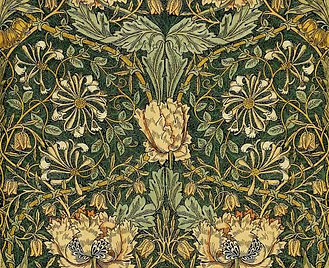
William Morris - Reinventing the English Country Ideal
By the late 19th century, artists and intellectuals were beginning to rediscover the beauty of traditional English craftsmanship.
Few were more influential than William Morris, a leading figure in the Arts and Crafts movement. Morris opposed what he regarded as the soullessness of mass production and championed craftsmanship, traditional materials and thoughtful design.
In 1871, he began renting Kelmscott Manor, a beautiful limestone house near the River Thames on the edge of the Cotswolds.
The house and surrounding landscape profoundly influenced him.
Other designers and craftspeople were also attracted to the region. Chipping Campden, in particular, became an important center of the Arts and Crafts movement.
The emphasis on craftsmanship, natural materials, beautiful interiors and understated quality that characterised the movement can still be felt in many of the Cotswolds' finest hotels, restaurants and independent shops.

From Rural Agriculture to Luxury Escape
In the last two centuries, perceptions of the Cotswolds changed again.
What had been mainly an agricultural landscape became more celebrated for its historic architecture, countryside and traditional villages. In 1966, the region was protected as an Area of Outstanding Natural Beauty, today known as the Cotswolds National Landscape.
The Cotswolds has since developed into one of Britain's most desirable countryside destinations.
Historic estates have become sophisticated hotels. Old pubs have evolved into acclaimed gastropubs. Farm buildings have been transformed into beautifully designed retreats, while a new generation of restaurants, spas, boutiques and private estates has brought contemporary luxury to the countryside.
The luxury here is rarely about ostentation. At its best, it is about space, heritage, craftsmanship, exceptional food and the pleasure of slowing down.